Italiano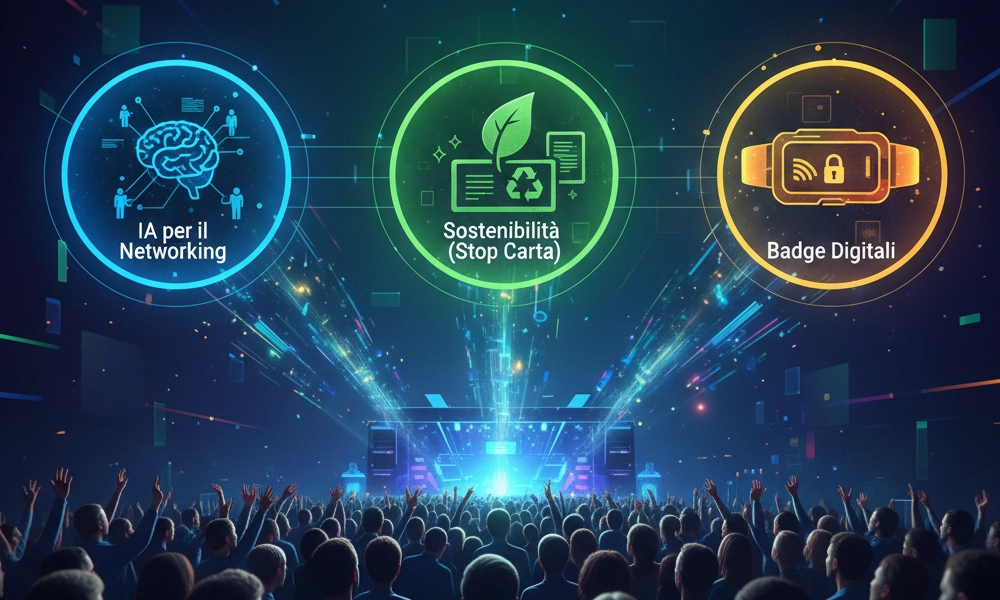
AI for networking: less random meetings
Networking is one of the main reasons people go to an event, but it is often left to chance: you meet whoever happens to be next to the coffee machine. Artificial intelligence applied to networking tries to change that, helping people find who can be truly useful.
The basic idea is simple: an algorithm reads the information attendees have entered in their profile, such as interests and professional goals, and suggests who to talk to. Imagine a purchasing manager at a trade fair: instead of wandering between stands, they get a suggestion to meet a supplier complementary to theirs who has indicated a shared interest.
In eventMe it works like this: an algorithm analyses the interest tags in profiles and proposes possible "best matches". From there attendees can message each other through a one-to-one chat, without swapping personal phone numbers or emails, or book an in-person meeting with the app's appointment system (page in Italian).
The quality of suggestions depends on profiles: the more carefully and voluntarily they are filled in, the more relevant the matches can be. No tool guarantees valuable meetings on its own: it is wise to measure results.
If you are interested in other tools to get the audience involved, read La sala si distrae? Gli strumenti per coinvolgere il pubblico di un evento dal vivo (in Italian).
Less paper: sustainability starts with simple things
Programmes, brochures, flyers, folders: at every event a lot of printed material is produced and soon ends up in the bin. Cutting paper is one of the simplest sustainability actions to start, and it has a practical advantage too: digital information updates in a moment.
- Digital documents: programme and materials viewable from a smartphone, with a QR code or a web app, instead of printed sheets.
- Less waste: less single-use plastic and local suppliers, where possible.
- A structured path: for those who want to go beyond single actions, recognised standards exist for the sustainable management of events, such as ISO 20121.
In event web apps, replacing paper is concrete: the interactive agenda updates in real time when a time changes, tickets and vouchers are sent as PDFs, and speakers' slides can be downloaded from a dedicated area after the event.
A tip on wording: avoid generic slogans such as "green event" if you cannot show what you did. The rules on environmental claims are getting stricter, and it is better to state precisely which actions you adopted.
Digital badges: more than a plastic-free name tag
A digital badge is not just a plastic name tag replaced by an image on the phone. It is a gateway to features paper does not have:
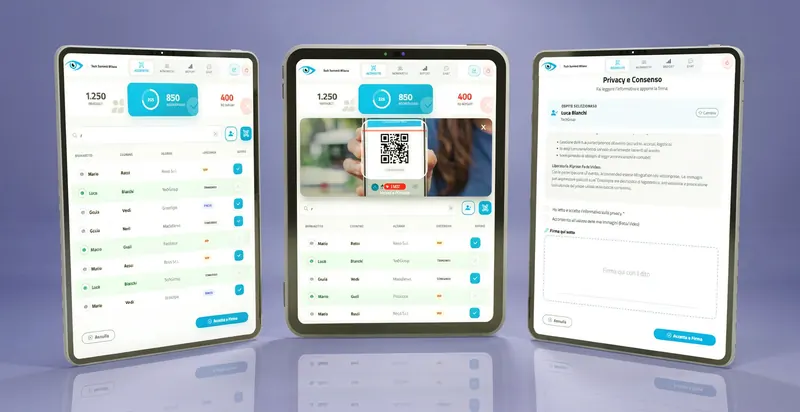
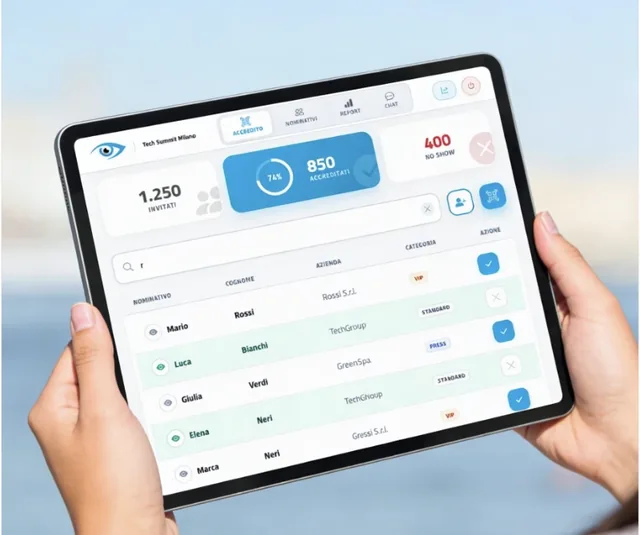
- Fast entry: the personal QR code is scanned at check-in, and attendance is recorded in real time.
- Contact exchange: a digital business card with a QR code saves the details straight into the other person's address book.
- Personal area: in one place the badge, documents and travel or stay information.
There are other badge technologies too, such as NFC and Bluetooth, which need different devices or arrangements: every event should assess their cost, practicality and privacy implications. To choose a check-in method read Check-in digitale: QR code, spunta o firma? and for alternatives to printed badges Stampa badge per eventi o alternative digitali: come scegliere (both in Italian).
If a badge or system also records attendees' movements, they must be informed clearly and the procedure assessed with a privacy adviser.
How to assess new tools without chasing trends
Not every new tool suits every event. Before adopting one, think about what really has to change and how you will measure the result.
Before adopting a new tool, ask yourself
When the tool allows it, look at simple things: how many attendees used it, how many meetings were requested and held, which documents were downloaded, what attendees think in a final questionnaire. Which data is available depends on the platform.
If you wonder why a web app may be preferable to an app to install, read Web app eventi: perché preferirle alle native (in Italian).
AI at events: transparency and privacy
Using artificial intelligence brings advantages, but it calls for transparency. Attendees need to know how their data is used to improve networking and the event experience.
- A clear notice: explain which profile data is used, for what and for how long.
- Voluntary choice: attendees should decide what to put in their profile and whether to take part in matching.
- Only what is needed: collect the minimum necessary for the stated purpose.
- Suggestions, not decisions: the algorithm's results are proposals, and everyone remains free to accept or ignore them.
For the correct set-up, have the procedure assessed by a privacy adviser based on your event. Transparent use of AI is also a way to build trust with attendees.
Frequently asked questions
It depends. At an event with few people who already know each other the advantage is limited. It becomes more useful at congresses and trade fairs, where attendees are many and do not know each other. It reduces waste of printed materials, but the overall impact also depends on transport, catering and energy. It is better to describe the concrete actions you take, avoiding generic slogans. Not always. At some events a recognisable name tag remains useful, for example to identify staff. Digital and physical badges can also be used together. With a clear notice, by collecting only the data needed, by limiting access by role and by having the procedure assessed by a privacy adviser.Does AI for networking make sense at small events?
Is an event with less paper really more sustainable?
Do digital badges always replace physical ones?
How is attendees' data protected?
Want to bring these changes to your next event?
Tell our team about your event: we show you what eventMe can do for networking, digital documents and badges, and how to adapt it to your brand.
Discover eventMe, the event web app