Italiano
From paper lists to digital check-in
Printed lists, pens and a wide margin for error: the old accreditation is now outdated. Digital check-in does more than let people in: it records who arrived, when and, if needed, with what confirmation. It is also a source of useful data for organising later editions.
There are three main methods, answering three different needs: getting in quickly, being certain of attendance, collecting a consent or agreement. If you first want to understand what can go wrong with check-in, read Accrediti all'evento: i 5 errori che creano code e stress, e come evitarli (in Italian).
QR code: when speed matters
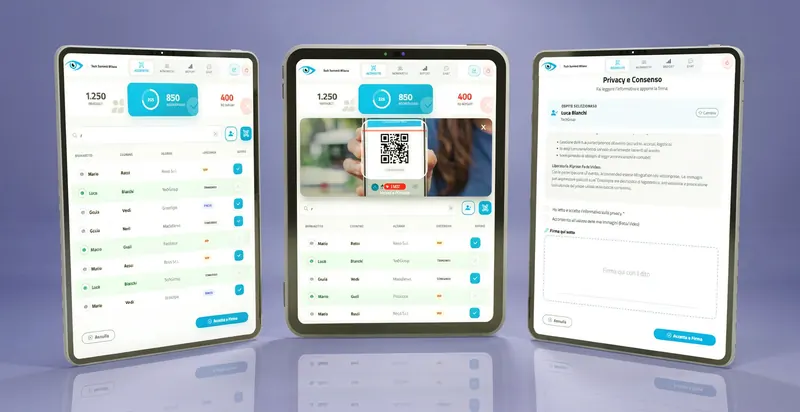
Each attendee receives a ticket by email with a unique QR code. At the entrance an operator scans it with a smartphone or reader: within seconds the system checks that the code is valid and records the entry.
- Strengths: it is the fastest method, greatly reduces queues and needs little staff. Codes and mailings are generated automatically from online registration, and you see attendance in real time.
- Keep in mind: the code confirms that the ticket is valid, not who is presenting it. If you also need to verify identity, the operator can add a visual ID check, following the procedure you set.
- Ideal for: trade fairs, congresses, concerts and generally large events where speed is the priority.
Our system is at QR code accreditation (page in Italian). If you have several entrances to manage, also read Troppi varchi, troppe code? (in Italian).
Digital tick-off: when certainty of attendance matters
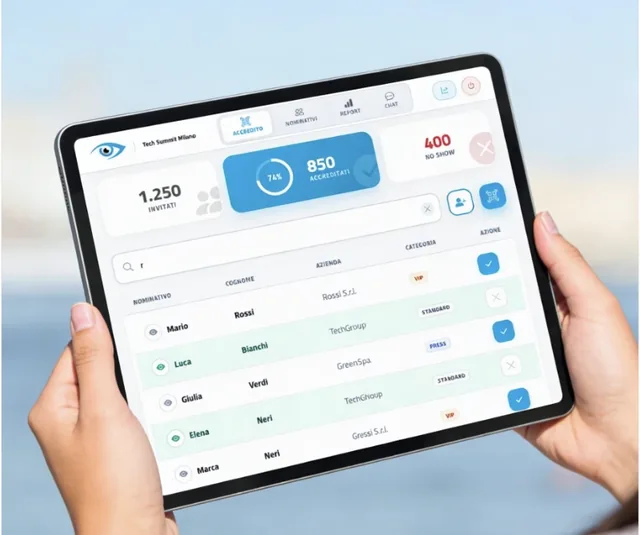
With digital tick-off the operator searches for the guest's name in the list and marks them present on a tablet or other device, with no paper. A QR code tells you a ticket was used; the tick-off records, for each person, that someone welcomed and checked them.
- Strengths: it works on named lists, shows each guest's access status, tracks operators and produces a final attendance report.
- Keep in mind: it is a little slower than a QR code because it involves a manual check. The level of verification (for example an ID check) depends on the procedure you set for the event.
- Ideal for: guest lists, courses, assemblies and closed-capacity workshops, where it matters to know exactly who was there. If you need attendance reports for training credits or for a body, ask them first which evidence they require.
More details at digital tick-off accreditation (page in Italian).
Electronic signature: when you need a consent or agreement
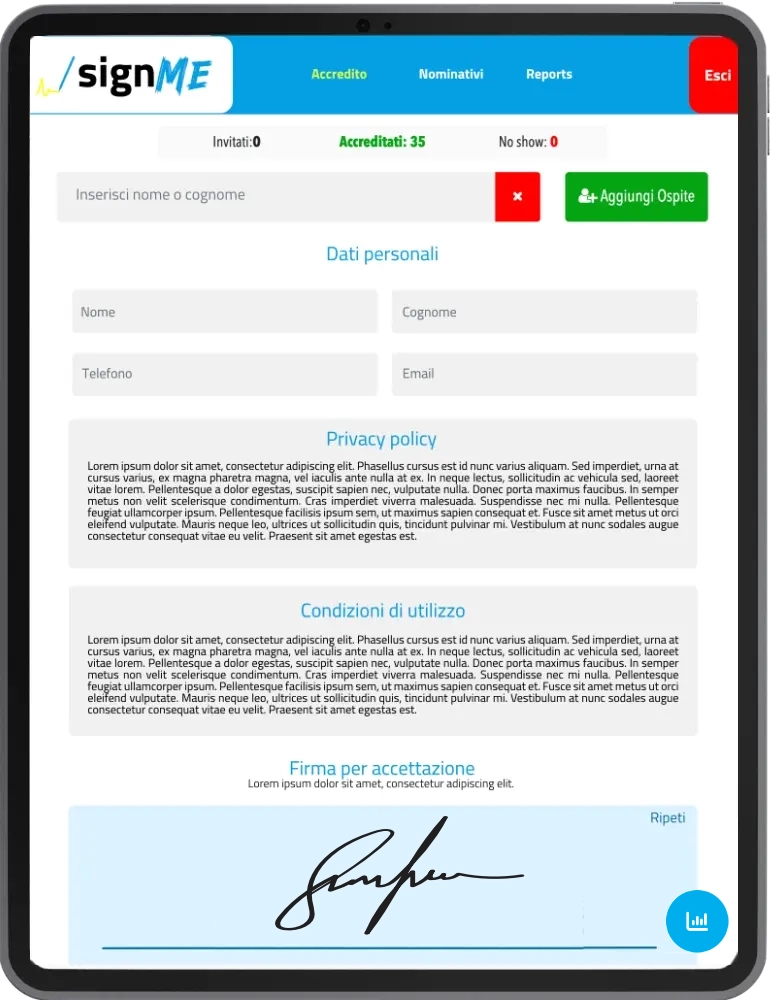
An electronic signature is not just for recording attendance: it formalises a consent, a release or an agreement. The attendee signs on a tablet at the check-in desk, with no paper. It can be useful for privacy releases, consents, non-disclosure agreements (NDAs) or video-recording authorisations.
Not all electronic signatures are equal. In brief, and simplified:
- Simple electronic signature: the lightest form. A court assesses it case by case, based on how it was collected.
- Advanced electronic signature (AES): links the signature to the signatory with stronger guarantees and makes the document tamper-evident. In Italy a document signed with an AES meets the written-form requirement for many acts.
- Qualified electronic signature (QES) and digital signature: the highest level. The EU eIDAS regulation (art. 25) gives it a legal effect equivalent to a handwritten signature. Some acts, such as certain real estate contracts, require this level by law.
The right type of signature depends on what you have signed and on the solution you choose. For documents with contractual value, consult a legal adviser before setting the procedure.
Our system is described at digital signature accreditation (page in Italian). For the personal data collected, it is also wise to involve a privacy adviser.
The comparison at a glance
| Method | Mainly serves to | What it records | Ideal for |
|---|---|---|---|
| QR code | Get in quickly | That a valid ticket was used, with the time | Trade fairs, congresses, concerts, large events |
| Digital tick-off | Be certain of attendance | That a person on the list was welcomed and checked by an operator | Guest lists, courses, assemblies, closed-capacity workshops |
| Electronic signature | Collect a consent or agreement | That the attendee signed a document | Releases, consents, NDAs, authorisations |
The more rigorous the procedure, the more time per person tends to increase: so choose the level of control you really need, without overdoing it.
To choose, ask yourself
You do not have to pick just one
The same event may need different methods, and a single suite lets you use them together without changing system. For example:
- QR code at the main entrance, to keep the line moving;
- digital tick-off for closed-capacity workshops, to know exactly who takes part;
- electronic signature at the speakers' desk, to collect video-recording releases.
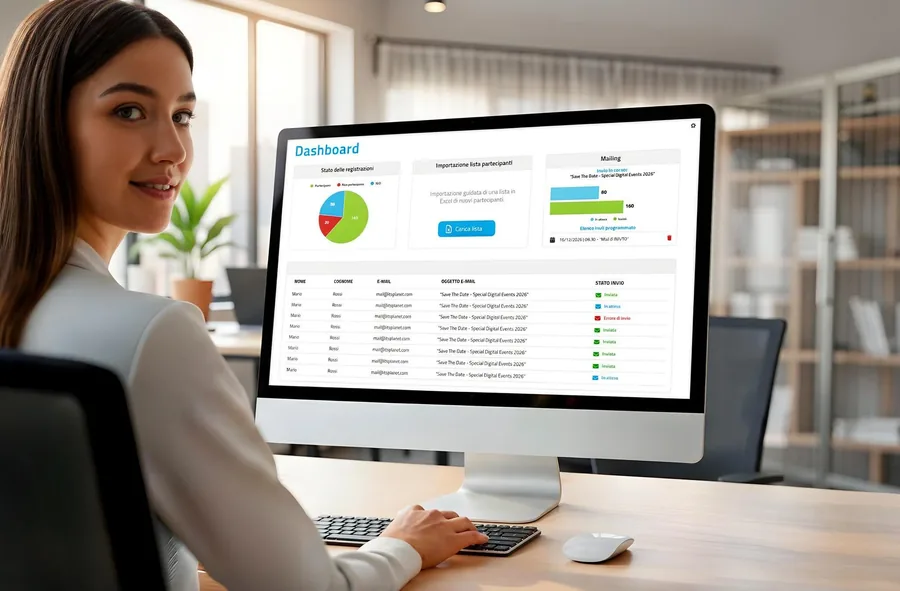
Data flows into a single, consistent dashboard. Discover our suite of event accreditation systems (page in Italian). For more on going digital, read Code all'ingresso del tuo evento? 5 motivi per passare all'accredito digitale and Software accredito eventi: le funzioni essenziali (both in Italian).
One last point not to forget: any accreditation system handles personal data. Ask the supplier how it is stored, for how long and who can access it, and have the procedure assessed by a privacy adviser based on your event.
Frequently asked questions
For many events yes, especially when speed is the priority. If you need to know exactly who is present or collect consents, it is wise to add digital tick-off or signature. It is an attendance record: its value depends on how it is collected and on what the body or client that needs it requires. It is not a signature. For cases with contractual or formal effects, consult an adviser. It depends on the type of signature. Under eIDAS a qualified signature has an effect equivalent to a handwritten one; an advanced one meets the written-form requirement in Italy for many documents; a simple one is assessed case by case. Ask your supplier which type it handles and check with a legal adviser. Yes, and it is often the best choice: QR code for entry, tick-off for controlled access, signature when a consent is needed.Is a QR code enough for every event?
Does a digital tick-off have legal value?
Is an electronic signature at the desk equivalent to one on paper?
Can I use several methods at the same event?
Not sure which check-in to choose?
Tell us about your event: we help you identify the method, or combination of methods, that best fits your number of guests, entrances and required checks.
Discover the suite of accreditation systems