Italiano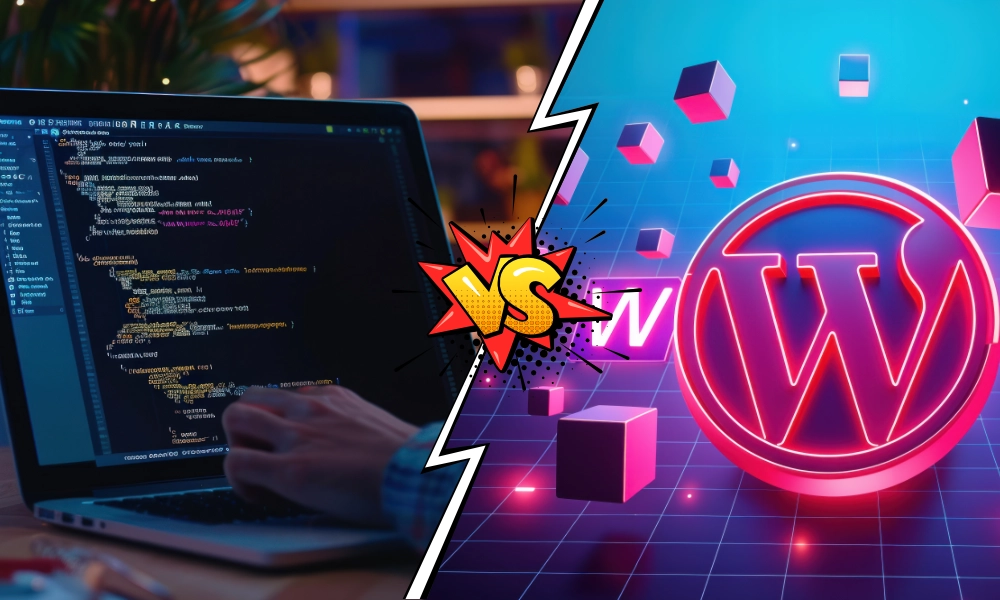
What CMS platforms are and why they're so popular
A CMS (Content Management System) is software that lets you build and update a website without writing code line by line. The most widely used platform is WordPress, which today powers over 40% of all existing websites — a figure that alone tells you how far this approach has become the default for anyone who wants to launch quickly.
The reason for its success is simple: intuitive visual interfaces, thousands of ready-made themes, and a plugin ecosystem that lets you add almost any functionality imaginable without touching a line of code.
The advantages of a CMS like WordPress
- Easy to use: even people with no technical background can create and manage content through visual (WYSIWYG) editors.
- Fast to launch: ready-made themes and plugins drastically shorten build time.
- Low upfront cost: WordPress is free and open source; you mainly pay for hosting, optional premium themes and some paid plugins.
- A massive community: documentation, tutorials and support are everywhere, which helps you solve most problems on your own.
- Scalable through plugins: you can add functionality over time without starting from scratch.
- Built-in basic SEO: dedicated plugins like Yoast SEO or Rank Math let you work on indexing without advanced technical skills.
The limits of a CMS like WordPress
- Customization only goes so far: deep changes to design or functionality often require genuine programming skills.
- Reliance on third-party plugins: the security and stability of your site partly depends on plugins you don't directly control.
- Ongoing maintenance: the core, the theme and every plugin need regular updates to stay secure and compatible.
- Risk of slowdowns: too many plugins or a poorly optimized theme can weigh a site down.
- A prime target: being the world's most popular platform also makes WordPress the most targeted, if not properly secured.
A CMS like WordPress is the natural choice for a personal blog, a simple company showcase, or a project with limited budget and time: intuitive tools for publishing content, managing comments and connecting to social media, with no developer required.
Hand-coded sites: total control
Building a site "from code" means writing every line of HTML, CSS and JavaScript from scratch, without relying on a CMS. It's the approach we favor when a project demands maximum control over performance, security and design: more time upfront, but zero compromises on the end result.
The advantages of custom development
- Unlimited customization: the site becomes exactly what's needed, with none of the constraints of a theme or CMS.
- Peak performance: clean, purpose-built code means faster load times and a better user experience.
- Security designed from the ground up: no dependency on third-party plugins to constantly monitor.
- Full control: knowing every line of the source code makes it easier to step in and fix issues.
- An architecture built for the future: the structure can be designed from day one to support the project's growth.
Loading speed isn't a cosmetic detail: according to Google research, the probability of a visitor abandoning a page rises by 32% when load time goes from 1 to 3 seconds. Lean code, typical of custom-built sites, works directly on that factor.
The limits of custom development
- Longer timelines: building everything from scratch takes weeks, not hours.
- Higher upfront investment: the work of experienced developers costs more than a ready-made CMS.
- Maintenance requires technical skill: every future change still needs a development intervention.
- Features to build, not to download: every component has to be developed specifically, which takes time and dedicated resources.
How to choose between the two paths
| Factor | CMS (e.g. WordPress) | Custom development |
|---|---|---|
| Upfront budget | Lower | Higher |
| Launch timeline | Fast | Longer |
| Skills required | Minimal | Specialized |
| Customization | Good, within theme limits | Unlimited |
| Scalability | Good, via plugins | Maximum, on dedicated architecture |
| Maintenance | Ongoing updates | Targeted interventions as needed |
Questions to ask yourself before deciding
- What's the site's goal? A simple showcase has different needs than a complex platform.
- What resources do you have? Budget, time and the technical skills available in-house.
- How does it need to grow over time? If you expect increasingly complex features, it pays to design the architecture from the start.
- How much does security matter for this project? Sensitive data or transactions call for extra care.
- What user experience do you want to offer? Speed and navigability affect both conversions and rankings.
Choose a CMS if:
Frequently asked questions
It can be, within certain limits. For business sites with standard functionality, WordPress is often enough. When you need complex integrations, high performance or a fully custom design, hand-coded development offers greater freedom and control. Generally yes, because it doesn't depend on third-party plugins that need constant updating. Security still ultimately comes down to how the site is designed and maintained, regardless of the technology chosen. Yes, it's a common move as a project grows and the CMS's limits start to show. It requires a carefully planned migration, so you don't lose content or rankings already earned. It depends on the project's complexity: the gap can be modest for a simple site, or significant for a platform with advanced functionality. The cost should always be weighed against the value that added control delivers over time.Is WordPress suitable for complex business projects too?
Is a hand-coded site really more secure than a CMS?
Can you move from a CMS to a custom site later on?
How much more does custom development cost compared to a CMS?
Still not sure which path to take?
Every project has different needs: the I.T.S. Planet team works with you to assess goals, budget and growth plans, and recommends the solution that fits — whether that's a well-configured CMS or a site built entirely from scratch.
Discover our professional websites