Italiano
1. The evolution of the event secretariat
The event secretariat has always been a cornerstone of planning, coordination, and management for any event, from a corporate conference to an international trade show. The growing complexity of events — multi-location, hybrid, with increasingly international audiences — has demanded tools more capable than spreadsheets and one-off emails.
The global events market was valued at $736.8 billion in 2021 and is projected to reach $2.5 trillion by 2035 (6.8% CAGR), driven in part by growing adoption of digital and intelligent technologies in event management. Source: Allied Market Research, "Events Industry Market" (2025).
2. Why artificial intelligence has become crucial
AI applied to events now makes it possible to automate repetitive tasks, personalise communications, anticipate logistical needs, and optimise processes in real time. AI solutions analyse large volumes of data in seconds, providing useful input for:
- Selecting the most relevant content and communications for each attendee
- Optimising agendas and sessions based on expressed interests
- Managing check-in flows smartly, reducing queues and bottlenecks
- Analysing post-event data with predictive indicators to improve future editions
This is no longer a niche phenomenon: according to the UFI Global Exhibition Barometer 2026, 91% of companies in the exhibitions and events industry already use AI in some part of their business. Adoption is widespread, though not always strategic: many organisations still use it for isolated tasks rather than fully integrating it into secretariat processes.
Source: UFI Global Exhibition Barometer, 37th edition (2026).
3. What a smart secretariat platform can do
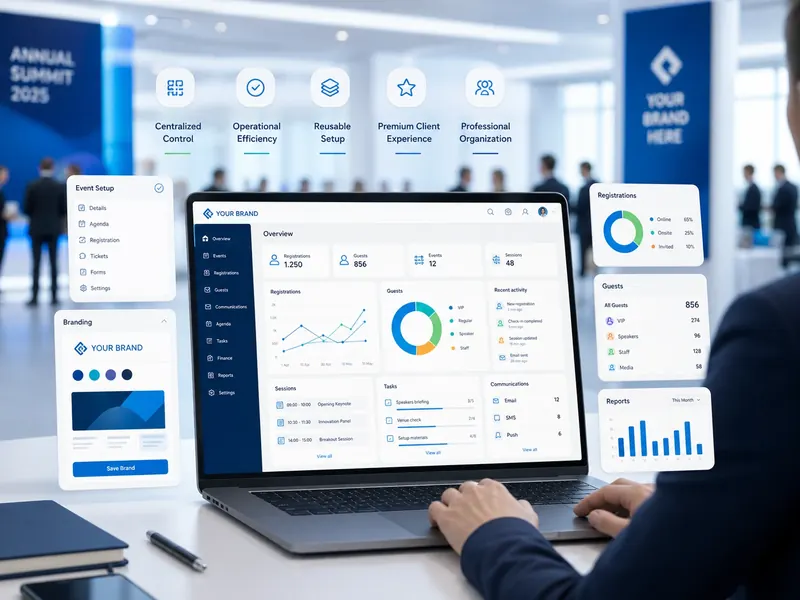
An AI-integrated event secretariat platform can support the entire event lifecycle, from first registration to final follow-up:
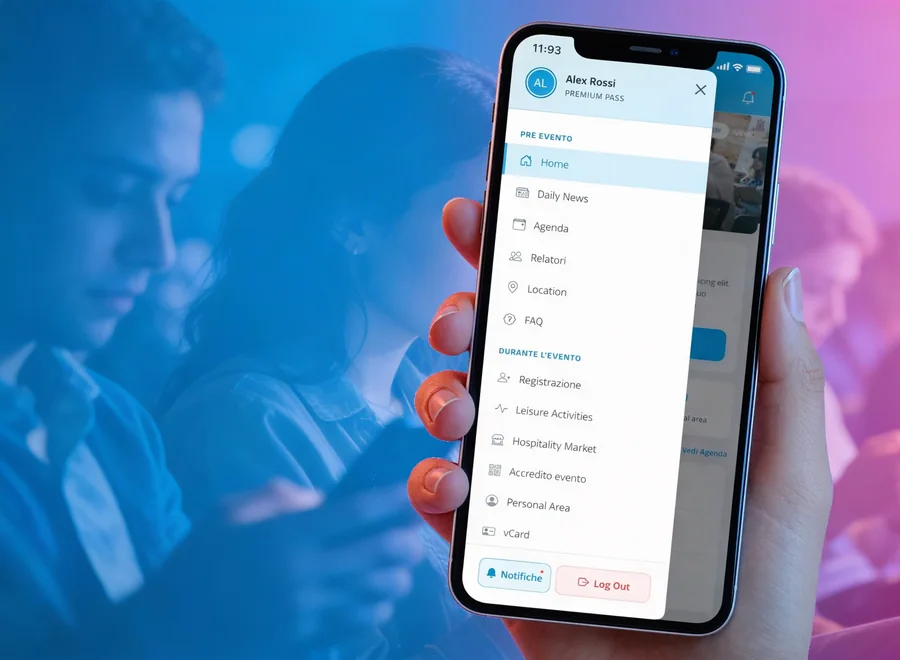
- Automated registrations via chatbots that answer attendees' most common questions in real time.
- Personalised invitations and smart follow-up, tailored to each contact's profile and behaviour.
- Analysis of user interactions to understand what's working in real time, not only after the event.
- Continuous support via virtual assistants, easing the load on the human team during peak times.
4. Concrete benefits and things to consider
Like any technology, adopting AI in the event secretariat brings tangible benefits but also requires attention to a few practical and ethical aspects.
Benefits
- Reduced operational load thanks to automation of repetitive tasks
- Less time spent on planning, without compromising quality
- Large-scale personalisation of content and agendas
- Continuous support for attendees and organisers via chatbots
- Real-time data and KPIs to improve future events
- Greater scalability for hybrid or multi-location events
Keep an eye on
- Privacy and data protection: GDPR compliance, encryption, access control
- Algorithmic bias: systems learn from historical data and can replicate its biases
- Risk of losing the "human touch" with excessive automation
- Resistance to change from untrained teams
- Initial investment that isn't always negligible
5. How to get started: 4 practical steps
You don't need to overhaul everything at once. Here's a gradual path to introducing AI into the event secretariat without disrupting existing processes.
- Start with a low-risk task. Automate answers to attendees' frequently asked questions (times, location, parking) first, with a simple chatbot.
- Measure the impact before scaling. Check how much team time is actually freed up before extending automation to other stages.
- Train the team on the new way of working. Whoever runs the secretariat needs to know how to oversee AI, not just how to use it.
- Integrate the data, not just the tools. Real value comes when registrations, check-in, and follow-up share the same data, instead of sitting in separate systems.
6. The future of event management
Technologies like conversational AI, predictive machine learning, and real-time data analysis are set to become increasingly embedded in event secretariat platforms. Agencies and teams that adopt these tools early aren't just saving time — they're using them to turn every event into a more personalised, coherent experience for attendees.
7. Frequently asked questions
Does artificial intelligence replace the event secretariat team?
No, it supports it. AI handles repetitive tasks and standard requests well, but strategic decisions, exception handling, and relationships with clients and sponsors remain the human team's responsibility.
Do you need technical skills to use an AI-powered secretariat platform?
No: platforms designed for non-technical organisers hide the complexity behind simple interfaces. Whoever runs the secretariat configures rules and content without needing to write code or manage the underlying infrastructure.
What data do secretariat chatbots handle, and how is it protected?
Generally contact details, preferences, and interactions with the platform. A GDPR-compliant solution includes data encryption, access control, and clear disclosure to attendees about how their information is used.
It's time to take the decisive step
Discover webRay, the guest management platform that combines chatbots and artificial intelligence for smarter, more efficient, and more engaging events.
Go to the webRay platform