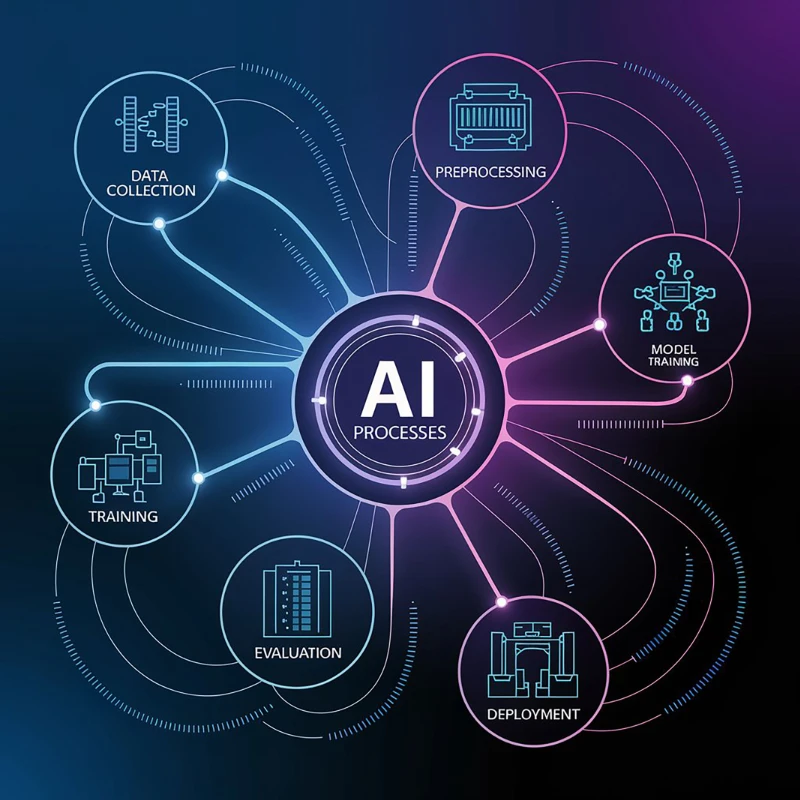
AI creates value when it enters processes, not when it stays an isolated demo outside daily work

Many companies have already tried generic tools, but the productivity leap happens when AI understands the context, uses the right sources and integrates with the systems where work actually happens.

Repetitive activities slowing teams down

Emails, tickets, checks, summaries, searches and form-filling consume hours that can be reduced with well-designed agents.

Information scattered across systems and documents

Company knowledge is often distributed across folders, CRM, ERP, databases, files and portals: AI can make it easier to access.

Generic and weakly managed AI tools

Without rules, permissions, logic and integrations, AI remains only partially useful and does not create stable business advantages.

AI roadmap for business processes
Business
AI

AI solutions organized around business goals

Not a technology showcase, but an operational roadmap to understand where AI can create real value.

At I.T.S. Planet we help companies turn AI opportunities into concrete projects: process analysis, prototypes, operational tools, automation, data control and connection with the existing digital ecosystem.

Use-case analysis

We assess processes, data, users and goals to separate useful initiatives from experiments that are too generic.

Prototypes and operational solutions

We start from focused pilots or MVPs to validate value, result quality and impact on everyday work.

Connected specialist paths

When the need involves assistants, chatbots or workflow integration, we route the project toward dedicated pages and workstreams.

Control, rules and management

We design limits, permissions, supervision, tracking and usage criteria to keep AI reliable over time.

When you need AI agents, chatbots or business assistants

If the main need is to create an assistant for users, teams, customer care, knowledge bases or back office, the dedicated agents page goes deeper.

Dedicated deep dive. The specialist agents page keeps the detailed keyword and describes use cases, features and application contexts.

Customer care and help desk agents

They answer frequent requests, retrieve information from knowledge bases and prepare responses aligned with company procedures and tone of voice.

Back office and document agents

They read attachments, extract data, classify cases, generate summaries and help complete repetitive steps.

Sales and management agents

They support analysis, briefings, follow-ups, reporting, lead qualification and fast data retrieval from CRM or internal systems.

Content and communication agents

They help produce controlled drafts, adapt text, summarize materials and keep consistency across channels and audiences.

What we mean by AI for businesses

We mean a set of tools, methods and integrations designed to improve real activities: information retrieval, operational support, automation, analysis and smarter interfaces.

AI use cases

These are concrete scenarios where artificial intelligence can classify, generate, summarize, search, suggest or check information.

Useful when you need analysis, interpretation, drafting support or intelligent reading of information.

Assistants and agents

These are operational solutions that help teams or customers retrieve answers, follow procedures, prepare outputs and complete recurring tasks.

Useful when you need contextual assistance, guided automation or orchestration of recurring activities.

Processes and systems

These are the links between AI tools, data, roles and business applications, needed when AI must become part of real work.

Useful for making AI concrete, current and genuinely valuable to the business.

Where AI can create operational value

We do not start from technology, but from flows where the company loses time: repetitive requests, hard-to-find information, manual steps, redundant checks and low-value activities.

Emails, tickets and requests

Automatic classification, priorities, response drafts, information retrieval and routing to the right department.

Internal procedures

Agents that guide operators through standard steps, check conditions and reduce operational errors.

Documents and attachments

Reading, summarizing, data extraction, version comparison and preparation of operational sheets.

CRM and sales activities

Customer data search, summaries, follow-ups, qualification support and guided information updates.

Events, registrations and hospitality

Support for event secretariat, guest requests, event FAQs, reminders, reports and check-in workflows.

Reporting and operational control

Preparation of summaries, indicators, anomalies and insights from internal data and authorized sources.

When you need to integrate AI into business processes

If the project requires connections with CRM, ERP, databases, documents, portals or operating procedures, the AI integration page explains the technical and organizational path.

Open AI integration
Databases and company data Controlled queries, data reading and authorized information retrieval.
CRM, ERP and management systems Connections with operating systems and existing registries.
Documents and knowledge bases Internal sources, procedures, manuals, PDFs, contracts and technical materials.
Contact channels Email, forms, portals, help desks and tools used by customers or teams.
Portals and web platforms AI integrated into web interfaces, dashboards and reserved areas.
Permissions and monitoring Roles, limits, logs, human review and action control.

Our focus is turning AI into real productivity, not an isolated feature

The benefits

More efficiency, more continuity, more control

The goal is to reduce repetitive work, shorten response times, increase information accessibility and make certain processes more scalable.

  • Reduction of manual and repetitive tasks
  • Faster retrieval of information
  • Better support for teams, customers or internal departments

How we develop a custom AI solution

We follow a path that starts from the use case and leads to the deployment of a useful, integrated and manageable solution.

01

Use-case analysis

We study where AI can generate real value: activities, users, available data, constraints and expected outcomes.

02

Logic and source definition

We design prompts, rules, context, information sources and the necessary supervision levels.

03

Prototype and validation

We build an initial testable solution to verify output quality, usefulness and process impact.

04

Technical integration

We connect the solution to company systems and the interfaces needed to make it operational.

05

Management and control

We define roles, limits, monitoring and usage criteria to keep the solution reliable over time.

06

Continuous evolution

We optimize system behavior based on real use, new data and emerging needs.

Why build a business AI roadmap

The value grows when AI is chosen around clear goals, available data, real processes and the team’s ability to adopt it.

Less manual work

AI acts on repetitive activities to reduce team workload and speed up operational steps.

Knowledge immediately accessible

Documents, archives and data become easier to query and turn into concrete support.

More continuous flows

Integration with existing tools makes the solution more coherent, current and easier to adopt.

Control and growth

A well-designed solution can be monitored, improved and adapted to business change.

Brands that used our web software

Client that used our software

Useful answers before starting an AI project

A concise view of use cases, data management and validation steps.

We build agents for customer care, back office, knowledge bases, document analysis, sales support, reporting, request management and recurring task automation.

Yes. We can connect the agent to CRM, ERP, databases, documents, web portals, APIs and internal tools, defining permissions, logic and operating boundaries.

We define sources, permissions, tracking and operational boundaries for the agent. The goal is to use AI in a controlled, verifiable way aligned with company policies.

Yes. We often recommend a focused prototype to validate value, answer quality, integrations and operational impact before scaling.

It reduces repetitive work, speeds up information retrieval, guides operators through standard steps and accelerates processes that currently require many manual checks.
Contatti I.T.S. Planet

Do you want to understand where AI can help your business?

Tell us about goals, processes and priorities: we can help choose the most sensible AI path, from the first pilot to an integrated solution.

Enter the result of the operation
Solve the operation shown and enter only the result.