Italiano
Moving beyond traditional accreditation
Remember the last time you organized or attended a training course? Long lines at registration, mixed-up names on paper lists, the difficulty of verifying who's actually in the room and for how long. These scenarios, still common today, are exactly what technology is quickly making obsolete.
Traditional accreditation, built on manual processes, isn't just inefficient — it's also error-prone, leading to frustration and lost data. For training events, where accurate attendance tracking is often essential for issuing credits or certificates, that inefficiency can have real consequences.
What does digital accreditation mean for training events?
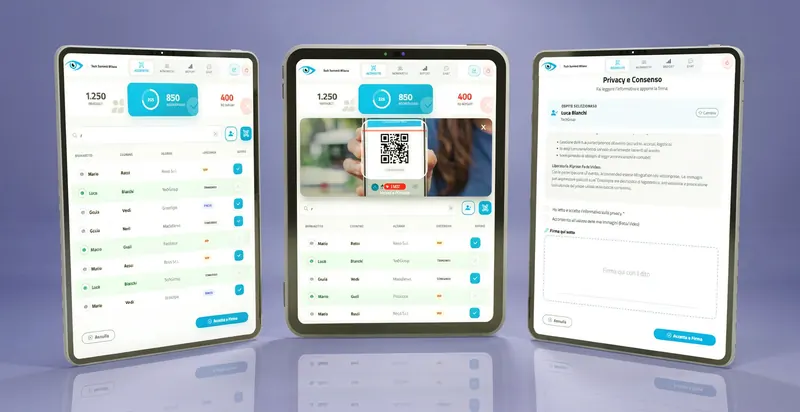
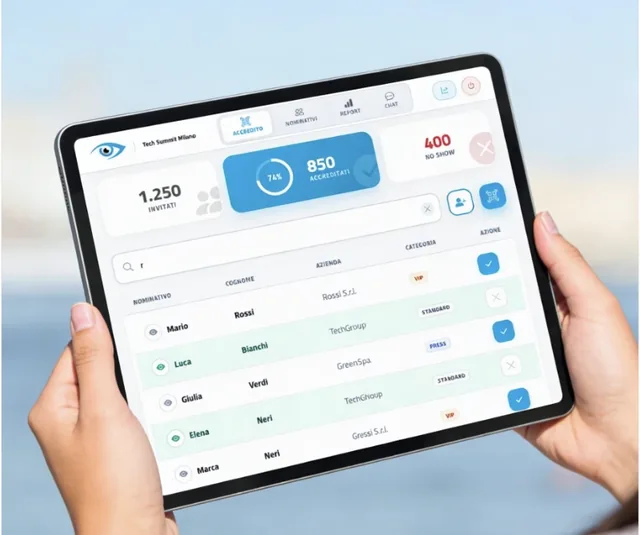
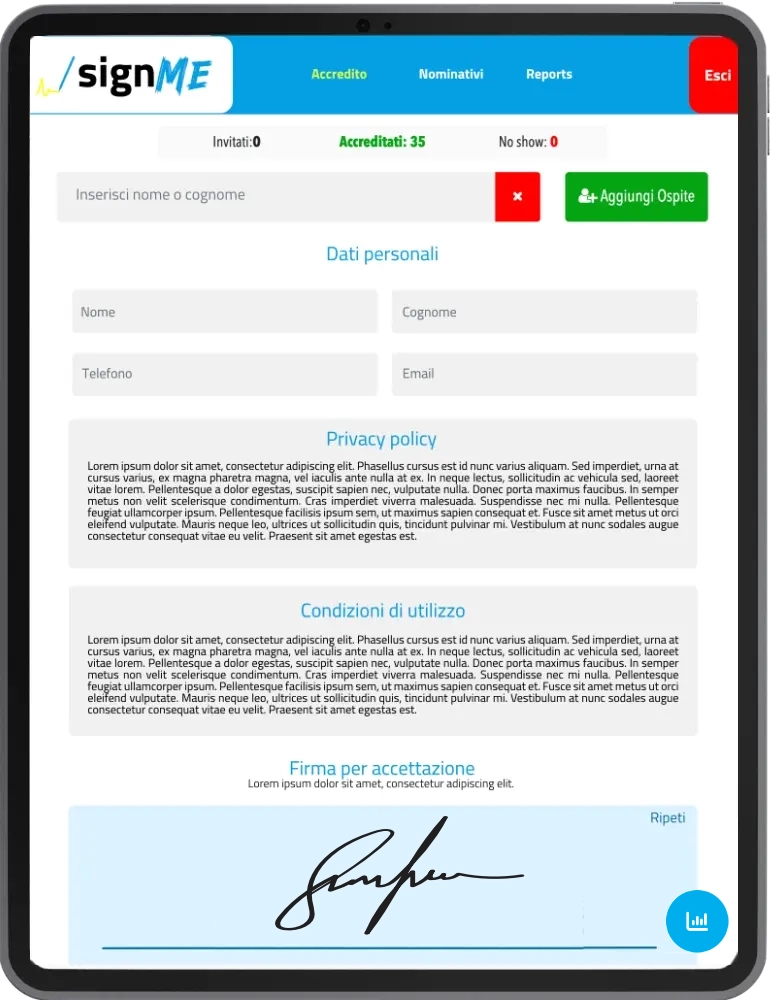
Digital accreditation is a system that uses software and hardware to automate and simplify the entire process of registration, check-in, check-out and attendance tracking. Instead of relying on pen and paper, it uses smartphone apps, tablets, QR code readers or NFC badges to identify and register attendees quickly and securely.
A system like this lets you:
- Manage online registrations from a central hub.
- Send registration confirmations and digital passes (often a QR code) by email or SMS.
- Check attendees in with a simple scan of their digital pass.
- Monitor in real time who is present, when they arrived and, if needed, when they left.
- Collect detailed attendance data for post-event analysis and accurate reporting.
- Automate the delivery of attendance certificates based on actual attendance.
A digital check-in software suite like goAhead was built precisely around these needs, offering a solution that covers every stage of the process. If you'd like to understand the technology behind it in more depth, take a look at our guide on QR code accreditation: how it works and why it's worth it.
The tangible benefits of digital accreditation for courses and seminars
Adopting a digital accreditation system delivers concrete benefits that noticeably improve how any training event is organized and run.
Efficiency and speed: no more queues and waiting
With digital check-in, registering each attendee takes only a few seconds. This translates into a drastic reduction in queues, letting courses start on time and giving attendees a calmer experience right from arrival.
According to Bizzabo's 2025 State of Events and Industry Benchmarks report, 71% of attendees say the smoothness of check-in can make or break their entire experience at an event — a direct confirmation of how much this first moment shapes overall perception.
Accuracy and fewer errors
Manual systems are inherently error-prone: misspelled names, illegible signatures, miscounts. Digital accreditation drastically cuts down on this kind of inaccuracy: attendee data is captured directly from the online registration system, and automated check-in eliminates most of the transcription errors typical of manual processes.
This matters a great deal when it comes to issuing continuing education credits (such as ECM for healthcare professionals in Italy) or certificates that require rigorous verification of attendance.
Real-time monitoring and advanced reporting
With a digital system, organizers can see in real time who's present, who's late and who's absent, with data available through intuitive dashboards. At the end of the event, it's possible to generate detailed reports on overall attendance, attendance at individual sessions, and how long each attendee stayed — valuable data for future planning and for any reporting obligations.
A better attendee experience
A smooth, modern check-in process contributes to a positive first impression: attendees perceive the event as well-organized and up to date. Receiving a pass by email and using a smartphone to check in adds a further layer of convenience.
Sustainability and lower costs
Doing away with paper forms, printed lists and disposable badges also means a smaller environmental footprint. And while there's an initial investment in the software, over the long run it can generate real savings by cutting printing costs, staff dedicated to manual registration, and time spent on post-event administrative work.
How a digital accreditation suite works
A suite like goAhead is designed to be intuitive, complete and flexible, adapting to different needs — from small workshops to large conferences.
- Pre-registration and digital invitations: the system integrates with your online registration platform, or provides a dedicated one; once registration is complete, the attendee automatically receives a confirmation email with a unique digital pass, typically a QR code that can be customized with the event's branding.
- Fast check-in: on arrival, staff with a smartphone or tablet scan the QR code; the system instantly verifies the registration and logs the entry. No expensive dedicated scanners are needed, and manual name lookup or barcode/NFC badges remain available.
- Multi-session monitoring: for events split across multiple modules, the system allows multiple check-ins and check-outs — morning entry, lunch break exit, afternoon return, final exit — ensuring the granular tracking essential for calculating training credits based on actual attendance hours.
- Automatic certificates: based on the attendance data collected, the suite automatically generates personalized certificates, emailed only to those who met the established attendance criteria — removing a heavy manual task from organizers' workload.
What to look for in a training-focused solution
There are several event management solutions on the market, but not all of them are built with the specific needs of the training world in mind. Here's what to check for.
Practical applications
Digital accreditation is used across a wide range of training contexts:
- Universities and training institutions: tracking attendance at lectures, seminars and labs, and managing access to exams or tests. A common case is orientation days, where digital check-in speeds up welcoming new students and captures useful attendee data.
- Corporate events and workplace training: tracking employee attendance at mandatory refresher courses or internal workshops, ensuring compliance and measuring training ROI — for example, certifying who has completed training on new safety regulations.
- Medical conferences and continuing education credits: essential for awarding credits, where every hour of attendance must be rigorously documented. Per-session check-in and check-out, with detailed reports required by accrediting bodies, dramatically simplifies reporting even for conferences with hundreds of attendees.
If you'd like to better understand the difference between managing a corporate event and a congress or conference, our deep dive on event vs. conference secretariat: key differences can help.
The future of accreditation: continuous innovation
The digital accreditation sector keeps evolving. Among the most interesting directions are integration with facial recognition technology (with privacy safeguards in place), the use of beacons for automatic proximity tracking, and artificial intelligence applied to attendance data analysis, for ever deeper insight into attendee behavior.
If you're still weighing a tick-based digital system against a QR-code-based one, our guide on event check-in: manual tick or QR code? can help you decide which approach best fits your event.
Frequently asked questions
What does digital accreditation mean for training events?
Is digital accreditation suitable for courses with continuing education credits?
How are attendance certificates generated?
Do I need dedicated hardware for QR code check-in?
Is digital accreditation GDPR compliant?
Ready to digitalize your accreditation process?
goAhead is I.T.S. Planet's suite for accreditation and attendance tracking at training events: check-in in seconds, accurate data and automatic certificates.
Discover the goAhead suite