Italiano
Gamification means applying game mechanics, such as points, challenges and leaderboards, to settings that are not games. At events it has a very practical purpose: moving people from listening to taking part.
It draws on three very human drives: the satisfaction of reaching a goal, a bit of friendly competition and recognition from others. Well designed, it increases engagement and makes the return on investment clearer, for organizers and attendees alike.
Why gamification works at events
Passive attendance is the number one enemy of any event. When people only listen, learning stays shallow and networking opportunities are wasted. Game elements break the monotony and give everyone a reason to get involved.
What the data says. In a 2019 TalentLMS survey of U.S. workers, 89% said they would probably be more productive if their work were more game-like, and 88% said they feel happier when using gamified tools.
On the learning side, a meta-analysis by Sitzmann (Personnel Psychology, 2011, 65 studies) found that groups trained with simulation games showed 11% higher declarative knowledge, 14% higher procedural knowledge and 9% higher retention. These figures come from workplace and training settings, not events: they show a direction, not a guarantee.
The main benefits
- More engagement. Points, badges and leaderboards push attendees to interact with the content, the speakers and the other guests.
- More active learning. People learn better by doing: quizzes during a talk, themed challenges and small simulations turn listening into practice.
- More natural networking. Breaking the ice is hard. Team challenges and contact hunts give people a reason to start a conversation with others who share their interests.
- More visibility for sponsors and partners. A sponsor's brand fits in naturally: a quiz question about its product, or its booth as a stop on a scavenger hunt.
- Useful data for the next edition. Knowing which sessions drew the biggest audiences and which speakers sparked the most interaction helps improve future events, with respect for privacy and attendee consent.
Four simple mechanics you can use right away
Making an event memorable does not require a huge investment. The mechanics below adapt to the size of the event and to the organizer's goals.
Points and leaderboard
The most classic and effective mechanic: assign points to the actions you want to encourage. A starting example:
| Attendee action | Points |
|---|---|
| Attending a session | +10 |
| Asking a speaker a question | +20 |
| Visiting a sponsor's booth | +15 |
| Exchanging digital business cards | +5 |
A leaderboard projected in real time on the venue's screens, for example with a social wall, shows who is most active and fuels the competition. Prizes can range from a gadget to a discount on future events: relevance to your audience matters more than cost.
Interactive quizzes and polls
During workshops and presentations you can launch quizzes and polls in real time, for example with pollMe. They keep attention high and let the speaker adjust the talk to the audience's level. The same goes for audience questions collected with askMe: the room becomes part of the session.
The scavenger hunt
Ideal for getting people to explore the venue and meet exhibitors. Attendees complete a series of tasks: taking a selfie at a specific booth, finding a hidden QR code, answering a question about an exhibited product.
Networking bingo
Each square on a custom card is a role or trait to find among the people in the room. The goal is to complete a row, or the whole card, by talking to other attendees. A few sample squares:
For a wider look at what you can activate in the room, read Engagement eventi: gli strumenti più richiesti.
How to choose the right platform
At large events it pays to rely on a dedicated platform, often built into the official event app, that awards points, updates leaderboards and runs quizzes automatically. Four criteria matter more than the rest.
Ease of use. The interface must be intuitive for both organizers and attendees.
Customization. Graphics and game mechanics should adapt to the identity of your event.
Integration. Check whether the platform works with the tools you already use, such as your CRM and social channels.
Technical support. During the event, a problem has to be solved fast: good support makes the difference.
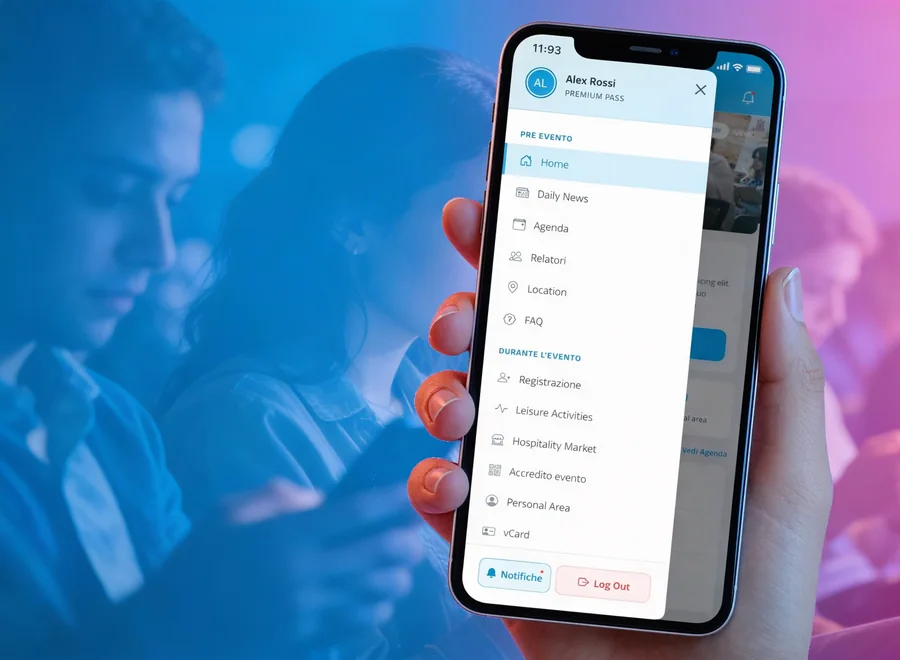
If you are looking for a technology base to build on, eventMe is a customizable event web app, with no download required for attendees, that lets you organize gamification activities your way. To better understand the role of apps in live interaction, also read App engagement eventi: come aumentare l'interazione live.
Getting started in five steps
Gamification is not a passing fad but a strategic approach that works when it is done well. These five steps help you set it up without mistakes.
- Set clear goals. Do you want more networking? More attention during sessions? Choose the mechanics based on the goal.
- Explain the rules in a few lines. Attendees should understand at once how to play and what they can win: complicated rules are the first obstacle.
- Choose desirable prizes. They need not be expensive, but they should be relevant and appealing to your audience.
- Do not be intrusive. The game is added value, not a distraction: it must not take attention away from the main content.
- Collect feedback. After the event, ask for opinions on the game experience: the suggestions are valuable for the next edition.
To look further ahead, also read Eventi 2026: IA, sostenibilità e badge digitali.
Frequently asked questions
No. You can start with a points system and a quiz during one session, and add more elaborate mechanics only if you need them. Yes, as long as the tone suits the audience. At a conference, for example, content quizzes and points-based networking challenges tend to work better than a scavenger hunt. By building them into the mechanics: a quiz question about their product or a booth stop on the scavenger hunt brings real visits. For centralized management, read Gestione sponsor eventi: come centralizzare e valorizzare. Which sessions drew the most attendees, which speakers generated the most interaction and which booths were visited most. It must be handled with respect for privacy and with attendee consent.Do I need a large budget to run gamification at an event?
Does gamification work at a formal or professional event?
How do you involve sponsors?
What data can you collect?
Bring gamification to your next event
Picture a room where people take part, challenge each other and get to know one another with ease, and an event everyone remembers. With eventMe you can build your own game experience, in a web app designed for your audience.
Discover eventMe