Italiano
For years the event secretariat has worked with spreadsheets, emails and paper documents, often in separate systems. It works for small events, but becomes unsustainable as attendees, speakers, suppliers and sponsors multiply, and as people expect a more personalized experience.
Event secretariat software and guest management platforms changed things: they automate invitations, online registration, participation fees, room assignment and feedback collection, with fewer errors and less wasted time. The next step is getting these tools to talk to the rest of the company.
Why integrate the event secretariat with business systems
A secretariat platform is an important step forward. But the data it collects is also needed by other departments: the CRM for sales follow-up, the accounting system for invoicing, marketing tools for later communications.
Picture a congress with thousands of attendees. Without integration, someone has to export data from the platform and import it by hand into the various systems: a long job, prone to errors and misaligned versions. Integration creates a continuous data flow instead, where information entered once reaches where it is needed.
The concrete benefits of integrated event management
- Less manual work. Automation frees the secretariat from repetitive tasks. In an integrated system, a registration can, for example, update the CRM profile, trigger invoicing and sign the person up to an event newsletter, without copying data by hand.
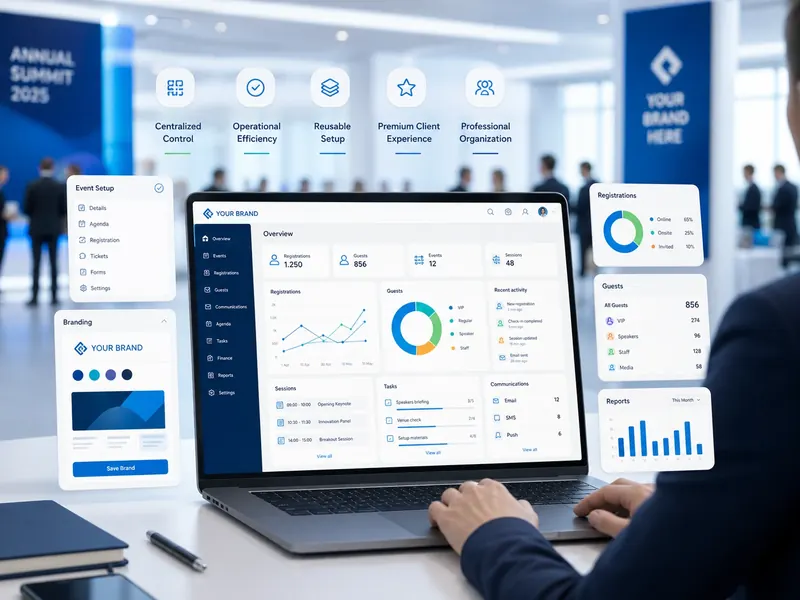
- Centralized, aligned data. A single source reduces duplicates and outdated information, and makes registration, attendance and feedback statistics available to different departments. For the basics, read Gestione iscritti eventi: perché usare un tool dedicato.
- A more personalized experience. With unified data you can send targeted communications and suggest sessions based on preferences given at registration, with respect for consent. Notifications are one channel: see Notifiche push su browser: come usarle nelle web app per eventi.
- Data-driven decisions. Analyzing attendance, session performance and return on investment helps adjust the program and plan later editions.
- Lower costs from errors and rework. Fewer manual steps mean fewer mistakes and less time spent fixing them.
webRay®: what it does and how it connects to business systems
I.T.S. Planet's webRay® is a guest management platform for events and congresses: it coordinates records, invitations, registration forms, logistics, communications, accreditation, payments and reporting. It is modular: for each event you activate only the parts you need.
The features that matter most for anyone integrating:
- Automations and communications. Scheduled emails, push notifications, SMS and Digital Wallet Passes work on the same database.
- Integrated payments. Stripe, PayPal and Nexi handle fees and additional services linked to the guest's record.
- Accreditation. Synchronization with goAhead, goAhead+ and signMe for digital tick-off, QR code and tablet signature.
- AI chatbot. An assistant available around the clock answers on program, location, access and registration, using content approved for the event.
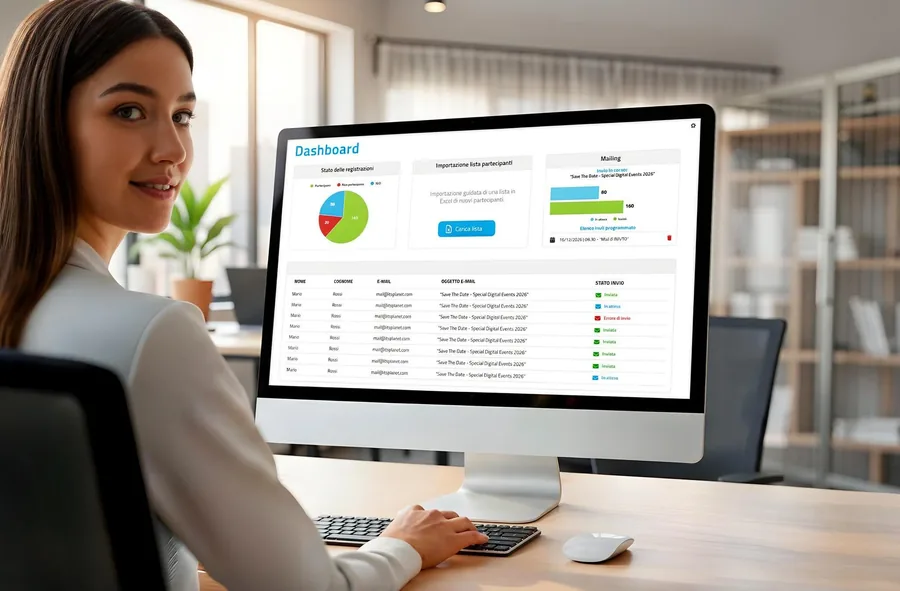
- Reports and exports. The secretariat can extract data to Excel without technical skills, with filters for arrivals, hotels, transfers, payments and accreditation.
On integrations, webRay® can connect to CRM, SAP, management software, authentication systems, payment gateways and third-party services. How this works in practice is defined case by case. For projects with SAP, look at web integrations with SAP.
How integrations work. APIs, webhooks, CRM, SAP, authentication and external databases are assessed according to the client's technical context and procedures, as well as the APIs available and the security policies of the systems to connect. That is why the first question is not "can it be done?" but "which data must pass from one system to another, and in which direction?".
A practical example: webRay® and CRM
One possible scenario, to be adapted to the CRM and the type of integration agreed. A company uses a CRM and runs an annual congress with webRay®. When a person registers:
- The data reaches the CRM. The record is sent to and updated in the CRM.
- The contact is segmented. The CRM classifies it by interest in the event.
- Marketing communicates in a targeted way. Personalized emails go out from the CRM to promote specific sessions or side events. For the email side, read Email eventi anti-spam: come evitare filtri e blocchi.
- The payment reaches the accounting system. webRay® records the transaction; if integration with accounting has been agreed, the information can trigger the issuing of the invoice.
- Feedback is linked to the profile. After the event, the responses collected are associated with the person in the CRM, for more targeted future interactions.
This way the two systems reinforce each other and management has complete data for decisions.
Challenges and best practice in integration
Integrating complex systems takes planning. The most common difficulties, and how to address them:
| Challenge | How to address it |
|---|---|
| Data structured differently across systems | Create a detailed map of how data moves and is transformed from one system to another. |
| Systems not built for integration | Check with the supplier beforehand which connectors or APIs are available and whether customization is needed. |
| Data security | Use encrypted connections (HTTPS), strong authentication for APIs and different permissions for each operator. |
| Privacy | More systems mean more flows of personal data: define legal bases, consents and roles, transfer only the data needed and review the setup with your privacy adviser. |
| In-house skills | Involve company IT and the supplier from the start: skills in APIs, databases and architecture are needed. |
How to proceed in five steps
- Set your goals. Which processes do you want to automate? Which data must be shared, and in which direction?
- Check what is possible. Analyze the integration capabilities of the systems you already use and ask the supplier which connections can be built and how.
- Map the data. Describe how data moves and is transformed between systems: this is the step that ensures consistency.
- Test in every scenario. Test the integration rigorously before the event and fix problems before going live.
- Train staff and monitor. Make sure people working on the systems know the new flows, then check the integration's performance over time and adjust.
If you need a platform built around your own flows, look at custom event platforms.
Artificial intelligence in integrated events
When data is tidy and connected, AI becomes more useful. Here are some applications, separating what exists from what is worth evaluating:
- Attendee support. webRay®'s AI chatbot answers frequent questions around the clock using content approved for the event, freeing the secretariat for the more complex cases.
- Attendance forecasting (to evaluate). With enough historical data, a model can estimate how many people will show up, supporting logistics and resources. Quality depends on the data available.
- Personalized journeys (to evaluate). Based on profile and behavior, and with respect for consent, sessions or exhibitors can be suggested.
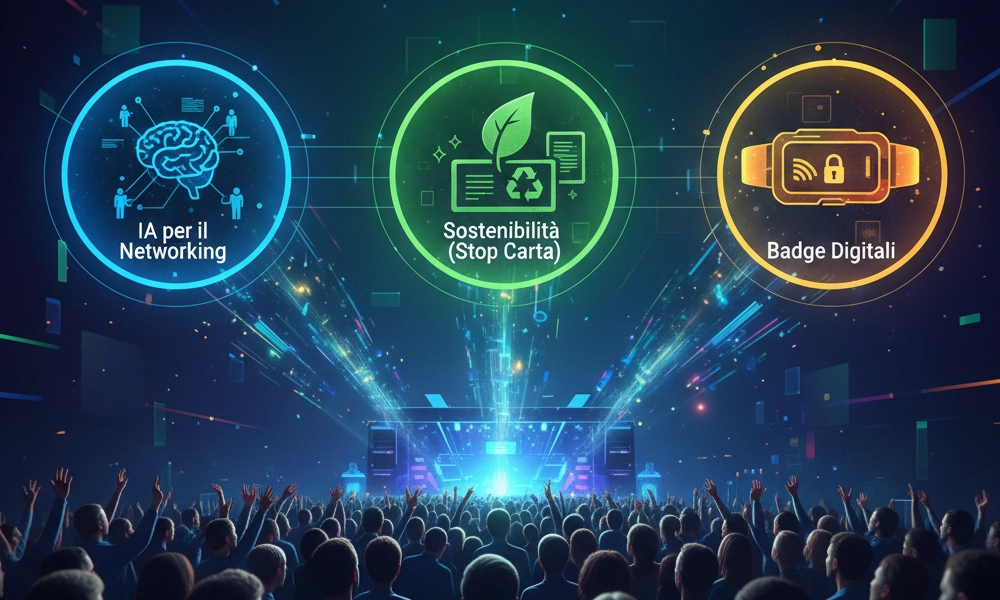
To bring AI into operational flows, connected to CRM and data, look at AI integration and workflows; for a look at trends, read Eventi 2026: IA, sostenibilità e badge digitali.
Integration is not a technology race: it means choosing which data should travel, where and why. Done methodically, it turns the complexity of an event into an organizational advantage.
Frequently asked questions
No. webRay® is a complete, modular guest management platform; integrations with other systems are an extension to evaluate based on your needs. Depending on the APIs available and security policies, webRay® can connect to CRM, SAP, management software, authentication systems, payment gateways and third-party services. Yes: records can be imported from Excel files and organized by profile, group, company or participation rules. No. Integration increases the flows of personal data to be governed. You need consistent legal bases, consents and notices, and it is wise to review the setup with your privacy adviser.Do I need a CRM or management software to use webRay®?
Which systems can it integrate with?
Can existing guest lists be imported?
Does integration make data automatically GDPR-compliant?
Get every registration where it needs to go
Picture every registration arriving where it should, without copying a single data point by hand. With webRay® we configure the platform around your event and assess together the integrations with the systems you already use. Tell us about your case.
Discover webRay®